A sloped backyard is not a problem waiting to happen. It brings levels, drama, and the perfect excuse to add stone steps, a tucked-away waterfall, or flowers spilling down the hill. From winding paths through wildflowers to retaining walls that double as flower beds, these hillside landscaping ideas can help turn a gentle incline or dramatic slope into an intentional, inviting part of the yard while adding structure and helping prevent erosion.
Desert Planting on a Gravel Slope

On a hillside, a treatment with fewer plants is one option. The light gravel on the backyard slope replaces mulch. Yucca and agave are planted in loose clusters.
A treehouse sits in a tree above the slope. This gravel-and-desert-plant landscape suits a dry climate and requires minimal upkeep after establishment, making it a recommendation when maintenance time or the water bill is a concern.
Mediterranean Hillside Steps with a Boulder Accent

The Mediterranean hillside emphasizes texture. The border is dense, but its growth stays loose and untrimmed. Lavender, yellow roses, and ornamental grasses fill it as it passes through the stone and brick steps.
Hard stone steps stand out against the soft plants, while the mix of plantings and stone follows the movement of the slope. Use drought-tolerant Mediterranean plants here if the area gets full sun and low water.
Stepping Stones in a Wildflower Hillside

Wildflowers around the stepping stones give the hillside a wild character. The planting keeps the path connected to the slope.
Straight stone steps pass through dense black-eyed Susans, daisies, and lavender on the hillside slope. The plants grow in a loose, full style around the steps.
Wildflower plants can thrive on slopes and need little maintenance once established. Use a wildflower seed mix to recreate the planting, and add mulch around the steps for weed control, while unmulched areas can grow in a self-directed way.
Stone Steps in a Green Courtyard

A narrow side yard holds two tall walls, with the hillside path positioned between them. This arrangement changes the character of the narrow space.
Dwarf conifers and Japanese maples frame the gentle flat stone steps. The steps pass through thick golden creeping groundcover.
Boulders along the path edges anchor the planting and help keep it from looking scattered. A mix of texture and color can then make shaded, awkward side slopes into a feature.
Cottage garden slope with stone steps

The hillside design appears naturally grown, even though it is planned. A citrus tree, spherical boxwood, and overgrown greenery line the steps. Wide stone steps run through the slope, with river rock edging the step edges.
For cottage style, layered planting and stone steps are recommended. A small pond at the step base catches runoff and adds a reflection.
Fire Pit Clearing in a Minimalist Hillside Design

On a hillside, use restraint when planning the space. Hillside design does not always require flowers.
The steel fire bowl rests on a circular stone pad set into the grassy slope, with the concrete bench also sitting on the same pad. Along the path edge, timber posts form a row and mark the path.
Consider a fire pit clearing for a wooded or coastal property. Loose native grasses line the clearing edges, and the hillside hangout spot can feel intentional without needing to be fussy.
Boulder and Stone Staircase to the Garden Gate

A staircase made from stone and boulders leads toward a garden gate, with the gate serving as the staircase goal. Beside the uphill stone steps, boulders and ornamental grasses frame the route as it passes between them. At the step terminus, a wooden gate sits inside a simple cedar arbor.
The climb can feel shorter when a visual destination is waiting at the top. For a path between distinct spaces, frame the path top with a cedar arbor, which provides that destination and changes the user experience.
Paver Path Stream
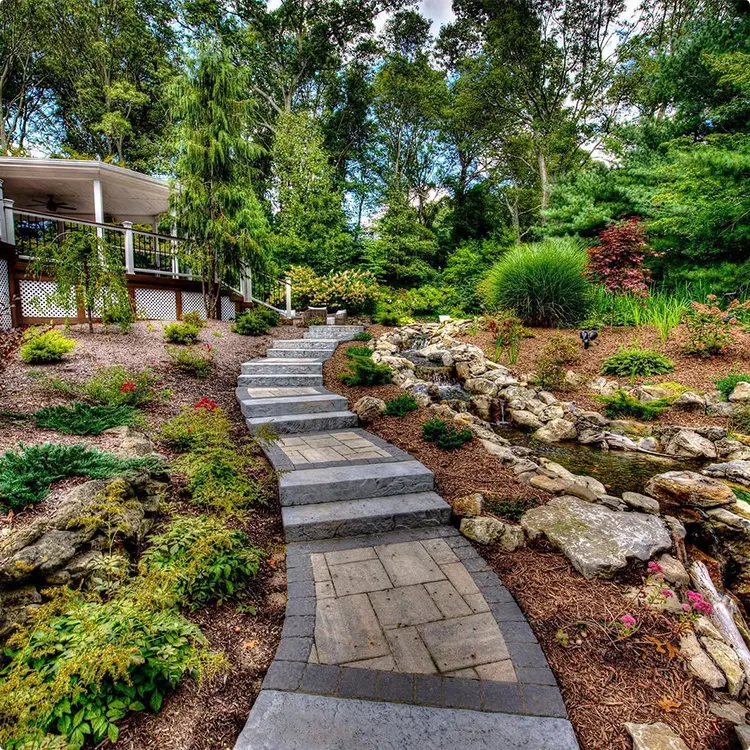
The running stream beside the hillside steps can give the backyard the feel of a retreat. The paver stone path follows a gentle slope, with a trickling stream running alongside it. That rock-lined stream is supplied by a small waterfall higher up.
Mulch beds line the path edges, and a covered deck sits at the top of the slope. The path and water move together without competing for attention.
Boulder Retaining Wall on a Front Yard Slope

A boulder retaining wall turns the slope challenge in the front yard into a landscape feature. A large, low retaining wall made from natural stone sits on the front yard slope. It supports a planting bed above the wall.
The retaining wall holds back the front yard, while a maple adds height, pink astilbe adds color, and ornamental grass brings movement. Together, the landscape performs a dual function and supports the home’s arrival.
Natural Boulder Stone Steps on a Wooded Slope

Use the hillside’s existing features. Large slab stone steps are set into the slope between boulders and trees.
Low lantern lights sit along the step edges. Natural moss and groundcover fill around the steps and spread over time, keeping the growth and the steps from looking uniform. Skip formal landscaping.
Brick Walkway on a Hydrangea Slope

Hydrangeas can express affection. Here, they are the main subject of the planting.
Blue and pink hydrangeas line both sides of the staircase. The stairs combine brick and stone, creating a lush planting effect without making the area feel chaotic.
Petunias and grass stay lower in front of the tall hydrangeas behind them, so the plants remain visible. Layering the planting this way prevents blocked views.
Path lighting at the base of the hydrangea path produces a glow after dark. It is an option for a hillside and path that receive decent sun.
Lit Stone Steps

Simple steps can have a big impact at the approach. Thick groundcover follows a slight curve beside the path. Flat stone steps climb the slope between boulders and beside the groundcover.
Small lights placed on each step help the path increase nighttime use of the hillside. Keep the plant palette low as well, since low plants compete less with the stairs.
Seating Area with a Tiered Waterfall
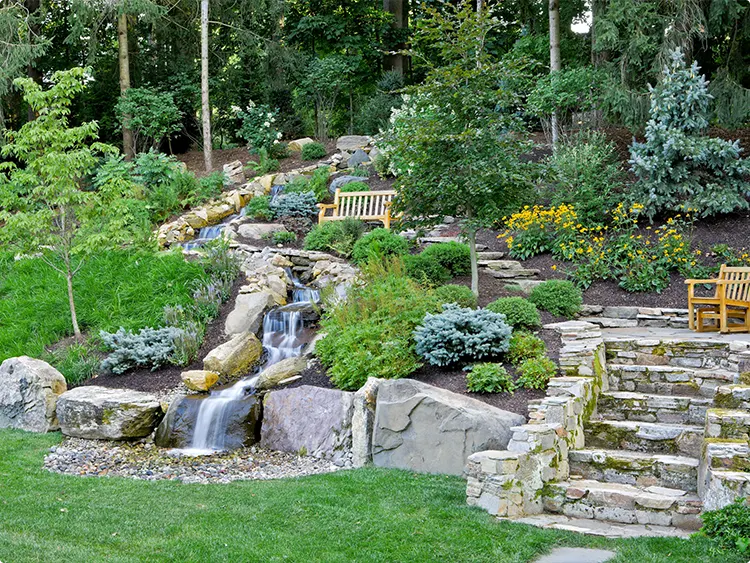
The hillside contains a tiered water feature. Its structure is built in levels as it moves down the slope.
Natural stone ledges support multiple small waterfalls that cascade downward into small pools. The water feature continues toward the lawn.
Stone steps beside the waterfall connect the patio to the yard. Benches near the waterfall base support sound enjoyment, while a large waterfall design calls for a larger budget. Work with the slope instead of fighting it.
Hillside Gazebo with Curved Stone Beds

Around a hillside gazebo, use curved beds so the planting plan matches the gazebo shape. The bed lines follow the structure rather than treating it as a separate feature.
Stacked stone beds form soft arcs around the gazebo base. The beds contain roses, salvia, and trailing greenery that grows over the edge.
Curved planting beds connect the hardscape and planting around a gazebo or pergola on a sloped yard. They soften the gazebo structure without hiding it.
Rustic Waterfall Landscape Behind a Cabin
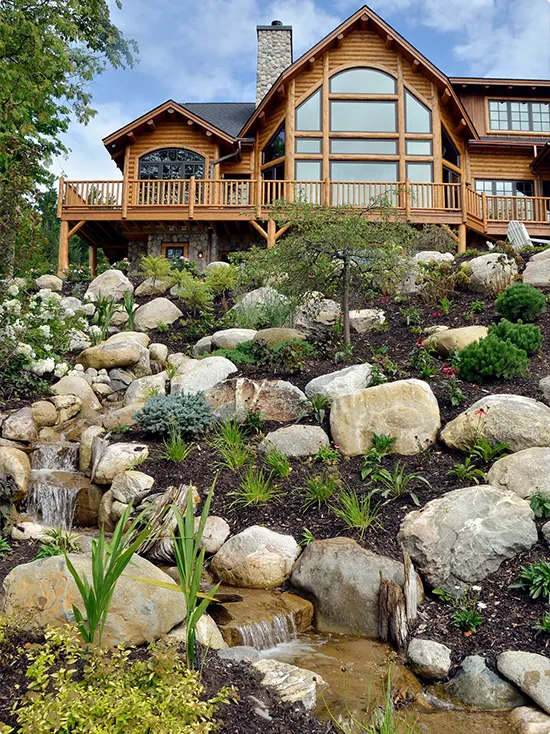
Behind the cabin home, the hillside is suited to a waterfall landscape. This approach is recommended for a cabin-style home. A small waterfall runs between varied boulders on the slope and flows into a small pond at its base.
Plant pockets between the rocks with conifers and grasses. The rock-and-plant arrangement resembles a mountain stream, and the waterfall creates water sounds that can be heard from the deck above.
Modern Stone Terrace on a Steep Slope

At dusk, the steep-slope terraces of this modern backyard remain visible. The stone terrace shapes the yard on its steep slope.
The ornamental grasses sit between gaps in the massive stone slabs. Stepped downhill, the slabs form a series of broad levels.
A covered patio sits at the top, with string lights placed in the upper area. For a modern hillside, use fewer, larger stone elements to reduce visual busyness.
Mulched Mass Planting for Slopes
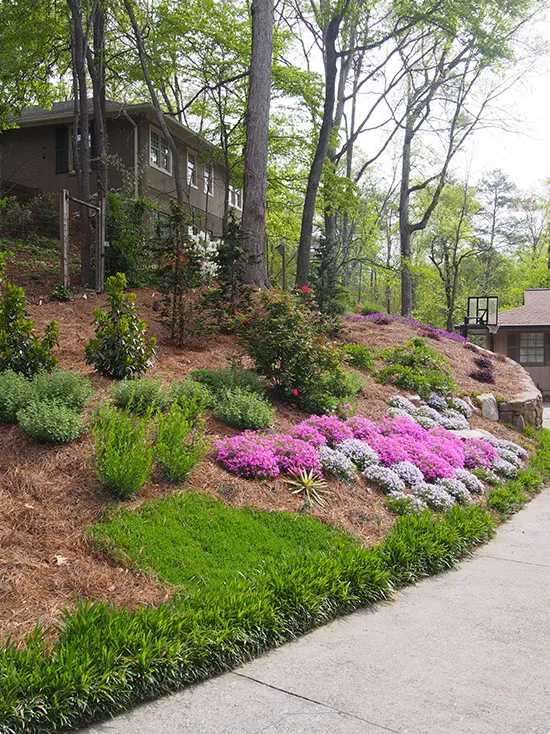
Maintenance stays low with mulch and mass planting. Mulch and mass plantings can cover the entire slope, including areas where regular mowing is difficult. On an angled slope, grass is harder to mow than these alternatives, while both mulch and mass plantings cover the full area.
Liriope grows along the bottom edge beside the walkway, while pink and white azaleas fill the middle of the slope. Mulch and mass planting keep maintenance low.
Illuminated Stone Stairway

A staircase can make the hillside feel like an entrance rather than an obstacle. Small recessed lights are built into each step of the long concrete stairway, which runs up the slope.
A well-lit stairway can become the main yard feature on a smaller property, while also changing the feel of a steep yard. Young trees sit along its side, and an apparently nearby vineyard beside the stairs adds to the setting.
Stone steps rising along a tight slope, built from stacked stone

A hill with limited space requires a stacked-step design that fits into the little room available. The short stone steps run straight uphill through a steep, narrow section. Made from stacked stone, they sit between a retaining wall and an evergreen stand beside the steps.
Gravel covers the area around the step base, where grass struggles to grow. Gravel is also recommended for side-yard slopes.
Curved Terraced Beds on a Steep Slope
Curved, ribbon-like terraced beds follow the steep slope. This is a high-ambition approach to hillside landscaping.
Red planting accents add detail to the individual strips, while greenery fills the terrace beds. Together, the terrace levels make the hillside design read as one continuous arrangement from top to bottom.
On a smaller slope, a pair or trio of curved terraces can be adapted to create a flowing structure.