
I think we all need a little more calm in our lives, and what better way to find it than by creating your very own peaceful retreat?
I’m sharing some of my absolute favorite Zen garden concepts today, packed with ideas to turn any space into a serene escape.
Elements of Asian Gardens
Stone Lanterns
One of the main goals of a Zen garden is to create a perfectly balanced and harmonious space for meditation, so man-made features are usually avoided. The big exception to that rule? Stone Lanterns, also known as Pagoda Lights!
They come in all sorts of forms and sizes, with different details and decorations. I love them! They were originally made to hold oil lamps and candles. These pagoda-shaped Stone Lanterns are placed in special spots around the garden and act as both a light source and a beautiful artistic accent.


Moss Gardens
You might be surprised to find out that moss is often the only living thing in Japanese Zen gardens, and that’s because it’s so tough and can endure super harsh conditions. I’ve always seen it as such a calm and unpretentious plant; it really only needs some shade and moisture to look amazing.
In the mild, humid climate of Asia, moss is everywhere. Its color can range from a deep green to a yellowish hue, and it works so well in both water gardens and dry setups.

Japanese Maples
The Japanese maple, or Acer palmatum, is a gorgeous tree that grows to a max height of 6-8 meters and is found across Japan, China, Korea, and East Mongol. Its wide leaves have this really distinct pattern with five or seven points.
The coloring can vary, but my favorites are the ones with those stunning, bright red colors.

It’s precisely because of its spectacular colors and attractive shape that the Japanese maple is such a popular choice for Bonsai art and Asian landscape design. The masters of Zen gardens use these living Japanese maple trees to add bold pops of color to their compositions, almost like an artist’s brushstroke.

Raked Sand and Pebbles
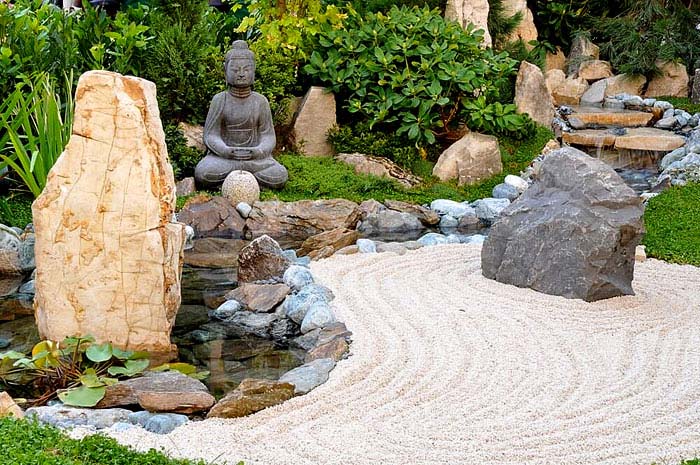
In the stylized landscapes of Zen gardens, you’ll see spaces of waved gravel that are meant to represent seas and rivers. It’s so clever! A bunch of carefully created shallow furrows and patterns symbolize the waves and movement of water, which brings a dynamic feeling to the whole design.
The most commonly used material is crushed white or beige granite, which is shaped with special rakes. Honestly, those precise lines and waves of granite and gravel are one of the most iconic and characteristic visuals of Zen garden design.


Statue of the Buddha
The statues of Buddha are another key element in Asian Zen garden design. They’re often used in a wide variety of cultural and artistic styles. I think they represent such a beautiful combination of human and nature, of spiritual and artistic expression.
The statues are usually placed in a secluded, meditative spot deep within the gardens. Another classic Asian statue you might see are dragons. They have a very specific look and a rich cultural meaning in this part of the world.
Whether they are made from stone, ceramics, or metal, these Eastern statues bring a special Asian spirit to the garden’s design.


Zen Garden Gates
Zen Garden Gates, or torii, have a role that’s mostly decorative and symbolic. Sometimes they don’t even have actual gate portals for closing. It’s just a simple wooden frame in an Asian style to greet visitors.
Their symbolic presence helps to mark the garden’s borders and creates this spiritual feeling that once you step under the arch, you’re entering a totally different world.


Arched Chinese Red Bridges
Those beautiful red arched bridges are a unique trademark of Chinese gardens. They’re typically small and traditionally made completely out of wood. The arch’s high point is usually the highest spot in the garden, which gives you the absolute best view of all the surrounding beauty.


Koi Fish Ponds
Water is such an essential component in Asian gardens. Whether it’s fountains, streams, cascades, or lakes with bridges, it always brings so much character and charisma. I love the way water and stone go hand in hand, representing the ying-yang dynamic. They contradict and complete each other in this continuous harmony.

And of course, the famous Koi Fish add a perfect pop of color and life to any water feature. They do just as well in big lakes as they do in small backyard ponds. They’re like genuine pets; they get used to people and can even be trained to eat from your hand.
Gorgeous and easy to maintain, Koi Fish have become a true trademark of Asian culture and garden design.


Stepping Stone Pathways
When it comes to Zen garden design, a key principle is “don’t leave anything to chance.” Every detail is thought out, including the paths you walk on to explore and feel the garden’s spirit. Creating walkways using Stepping Stone Pathways is absolutely essential for getting the design right.
These paths can guide you across gravel, moss, grass, and even water, inviting you on a step by step journey to discover the beauty and spiritual secrets of a Zen garden.


Stone Bridges
Another really characteristic element is the bridge. In mixed-style Asian gardens, it might be used to cross over water, or in dry stone gardens, it can create a dynamic pathway with different levels. They have to be made from natural materials, usually wood or stone.
In Japanese rock gardens, the bridges are often made of a single large piece of rock connecting two hills. The great thing is, it can be used not just as a path but also as a bench where you can sit and relax.


Rocks & Stones
Compositions of rocks and stones are probably the most important elements you’ll find in the Asian art of gardening. They give off a feeling of power and stability mixed with tranquility and a timeless sense.
With their rough, amorphous structure, they’re often used to create a beautiful counterpoint to the soft look of sand and water. It’s a contradiction that really makes you think.


Stone Water Basins
Stone water basins got their start in Japan, where they were traditionally used as a place to wash up before a tea ceremony. They’re called tsukubai, which literally means “stopping basin,” and they’re designed in a way that makes you bow to use them.
So, besides the practical purpose of cleaning, they also encourage a certain humility of spirit and get you in the right mindset for the tea ceremony. In today’s garden designs, stone water basins add more of a decorative value to the overall decor.


Contemporary Zen Backyards
In this section, we are going to check out some exciting ways the aesthetics of Asian Gardens can be brought into modern homes and settings.
Because today’s homes often have smaller spaces, modern designers have to get creative combining contemporary and ancient garden elements, which is definitely not an easy task!
So, we’ll take a close look at how the traditional Asian garden design elements we just talked about can be placed in real spaces, what combinations work, and how they can create that unique Zen Backyard spirit in a contemporary home.

A key characteristic of Asian gardens is the deliberate use of asymmetry. For example, if there’s a path, it never follows a straight line for the shortest route. Instead, it meanders between the most visually stunning spots in the garden.
The landscape is also designed so that you can never see the entire garden in one panoramic view. It’s meant to be explored and enjoyed from the inside to be truly understood.

This modern home in Singapore is just beautiful. Its fresh lake garden is situated right in the middle of the L-shaped house layout. The open interior spaces give a constant, direct view of the gorgeous garden inside.
This landscape uses a compositional approach that’s typical for Asian gardens, playing with the visual contradiction between the water and the floating islands. The trees and plants growing on the islands, along with the lighting arrangement, add an extra exotic feel.

This Contemporary Zen Backyard is another one dominated by the presence of water and decorated with luscious plants. The red splashes from the Japanese maple trees are casually spread out, creating a dynamic contrast with the bright greens of the oval-shaped coniferous plants.
A walking path made of granite blocks in a zigzag arrangement leads you across the water. The overall Zen feeling of the space is boosted by an ancient Stone Lantern accent, a bamboo fence, and an Asian-style garden shed.

In this example, we see the traditional gravel base shaped with circles and waves, which is classic for dry rock gardens. I think this solution is not only visually attractive but also super practical because the gravel helps prevent unwanted plants from growing.
Stepping Stone Pathways, a small rock fountain, and a wooden fence complete the feeling of a contemporary, Asian-themed backyard.

Here we have a stylish backyard with a cool urban feel that uses elements from Asian Zen gardening in its setup. Even though it’s a limited size, things like stone statues, river granite at the base of the tree, a meditation bench, and walking paths create this cute little space for relaxation.

Again, the walking path is the foundation of this composition. Solid rectangle blocks are placed in the center of the design. White gravel in the lowest part symbolizes water, and the stone walking path is raised one level above it, like a bridge crossing a river.
I love how the straight lines of the wooden platform frame the composition and are juxtaposed with the organic, oval shapes of the rocks and plants.

This is a modern take on a Zen garden from Australia. Its strong geometrical shapes, terraced cascade, and plant choices all revolve around the contrast of shapes and materials. It has two very distinct zones.
The flat square space with water, grass, and smooth surfaces, and the oval explosion of greenery. The space offers some really dynamic variety and contradictions.

Go ahead and check out the following gallery of Zen Backyards. It shows more elegant combinations of traditional Asian garden elements with a modern vision and style.


Some charming wood elements can also be part of a Zen garden. For those who want a complete Japanese-style home, it’s worth considering Shou Sugi Ban siding, also known as Yakisugi.
Shou Sugi Ban is this unique, ancient method of preserving wood with fire, which gives it a luxury, aesthetic look and makes it both fire and water resistant.


Indoor Zen Garden Ideas
This garden is located right at the entrance of a contemporary Korean house. The tall bamboo installation visually defines the staircase that leads into the home.
A stone pathway on a gravel bed takes us toward the other part of the house. The focal point of the garden is a stone cascade decorated with small green plants and moss.

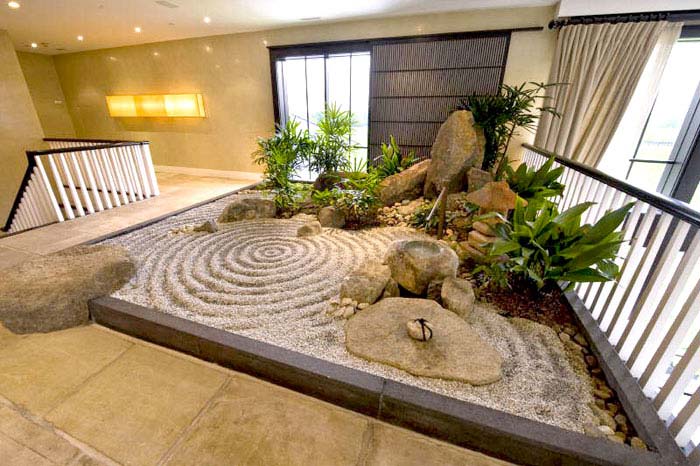
A Zen space can be moved completely inside the home, even on the second floor like in this case. The challenges of bringing a space like this into your interior can be significant, but if everything is planned carefully and executed cleverly, the result is absolutely spectacular.

The architects of this building found another really unusual solution. The Asian garden is located in the middle of the house, surrounded by glass walls with an opening above. This way, the bamboo can grow tall and get natural sunlight and rain.
Another great thing about this bright house is that the natural sunlight can freely enter the home’s interior. It’s such a harmonic interaction between inside and outside, based on the ying and yang principle.

This Dry Stone garden breaks the borders of what we normally see, penetrating the interior in a dynamic and unexpected way with its aquarium-like glass structure. It’s so provocative in style, making it perfect for office spaces where out of the box thinking is a plus.
Zen Inspired Public Spaces
Sometimes, forward-thinking architects borrow the elegant aesthetics of Zen gardens and, with a modern interpretation, integrate this style into public spaces and city landscapes.
Let’s check out some inspirational examples together of cleverly arranged relaxing spaces inspired by the East.


The first project is Roombeek the Brook, located in Enschede, Netherlands. An existing body of water was turned into a modern Zen garden with irregular patterns of rocks that slow down the water’s movement and bring tranquility and charm to the area.
The smooth stone blocks placed asymmetrically across the water are inspired by traditional Stepping Stone Pathways but give that concept a contemporary twist.

The Naturescape installation by Kengo Kuma, part of the Urban Stories exhibition in Milan in 2013, is a modern and provocative take on the traditional Japanese garden.
Cascades and layers of smoothly shaped stone waves are combined with water features at their lowest points, along with clusters of bamboo planted in the middle of gravel islands.


Sunken Garden in Beijing was created by Plasma Studio and shows us a contemporary urban style that’s influenced by the Chinese Shouzou gardens.
This city park is impressive, with its 3G projection and multiple hidden pathways and spaces that create a secluded feeling where you can harmoniously reconnect with nature.

Here are a few more relaxation spaces located in business buildings, where the architects used elements from Asian gardens to create a truly unique atmosphere:


Mini Zen Gardens
If you like the eastern style but don’t have the space to create a full scale Zen Garden at home, consider a miniature Zen Garden.

There are so many varieties of desktop zen gardens that you can buy online, and they bring that Asian harmony and charm right into your home or office.
They even make a great gift for someone you love. If you have the patience, creativity, and steady hands, you can create your own dry mini garden by following some simple instructions.
DIY Mini Zen Garden
To make your own dry desktop zen garden, you just need a shallow ceramic pot, some sand, and stones. If you’d prefer a composition with living plants, you’ll need some soil, a few unpretentious plants, and moss or even a bonsai. You can find full instructions on how to make a mini zen garden here.

Here is a charming example of how a miniature garden can even be placed in a glass jar. This creates such a fairytale-like atmosphere and a touch of extravagance, but it’s a more complicated task to set up and maintain a garden like this.


To wrap things up, I’d advise you to keep an eye out for Zen gardens popping up in home and space creation during the upcoming 2017-2018 interior design season.
In the middle of global events and our stressful, intense daily lives, we are realizing more and more that we need a tranquil and harmonic space for meditation, inspiration, and to recharge.

You can check “The Local Tree Experts” to learn more.